
If you’re pregnant and hearing about blood tests that can check your baby’s chromosomes as early as 10 weeks, that’s NIPT. It’s not diagnostic like amniocentesis, but it’s the most accurate screening we have — and it’s just a simple blood draw.
Here’s the complete, up-to-date guide for 2026.
What is non-invasive prenatal testing?
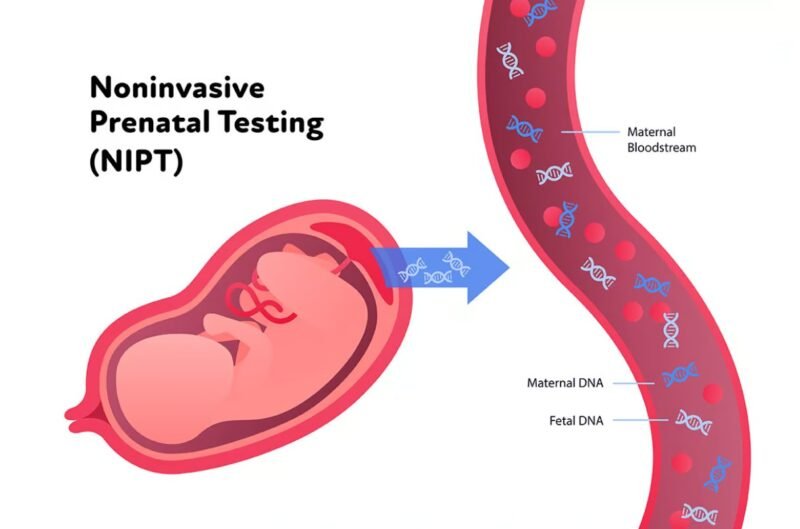
Non invasive prenatal testing (NIPT) is a screening test that analyzes tiny fragments of cell-free fetal DNA (cfDNA) floating in the mother’s blood. This DNA comes from the placenta, not directly from the baby, and can be detected as early as 9 weeks.
NIPT has been established as a routine prenatal screening to assess the risk of common fetal aneuploidy disorders (trisomy 21, 18, and 13). NIPT has high sensitivity and high specificity, but false positive and false negative results still exist.
Unlike older serum screening, NIPT looks directly at DNA, which is why accuracy is so much higher.
How does NIPT work?
- Blood draw at 10+ weeks: Maternal plasma contains 5–20% fetal fraction between 10 and 26 weeks of gestation.
- DNA extraction: Labs isolate cfDNA fragments
- Next-generation sequencing: Millions of DNA fragments are counted to see if chromosome 21, 18, or 13 is overrepresented
- Risk score: Results come back as “low risk” or “high risk” with a Z-score
No needle near the uterus, no risk of miscarriage from the test itself.
What does NIPT screen for?
Standard NIPT covers:
- Trisomy 21 (Down syndrome)
- Trisomy 18 (Edwards syndrome)
- Trisomy 13 (Patau syndrome)
Expanded panels (NIPT Plus) may add:
- Sex chromosome aneuploidies (Turner, Klinefelter)
- Rare autosomal trisomies
- Microdeletions like 22q11.2 (DiGeorge)
Benefits of NIPT
Non-Invasive Prenatal Testing offers high accuracy and earlier detection for chromosomal abnormalities like trisomy 21, reducing invasive procedures.
Key benefits:
- Earliest safe screen: from 10 weeks, weeks before anatomy scan
- Non-invasive: only maternal blood, zero procedure-related miscarriage risk
- High reassurance: for low-risk results, anxiety drops significantly
- Reduces unnecessary amnios: many women avoid invasive testing after a low-risk NIPT
- Works in twins: expanded NIPT showed high detection rates for common trisomies in high-risk twin pregnancies
- Convenience in India: free home collection and ISO-certified digital reports within 5-7 days are now standard with major labs
Accuracy: how good is NIPT really?
This is where NIPT shines.
A meta-analysis of 117 cohort studies in singleton pregnancies demonstrated sensitivity and specificity for:
- Trisomy 21: 99.4% sensitivity and 99.9% specificity
- Trisomy 18: 97.7% and 99.9%
- Trisomy 13: 90.6% and 100%, respectively
Other large studies agree:
- A study comparing NIPT and amniocentesis found NIPT showed 100% sensitivity and 100% specificity, matching amniocentesis
- A 146,958-pregnancy study found high sensitivity (99.17% for trisomy 21) and specificity (99.95%)
- Clinical reviews note NIPT detects Down syndrome with 99.5% accuracy using maternal blood tests
Translation: for Down syndrome, out of 1,000 affected pregnancies, NIPT will correctly flag about 994, with very few false positives.
But remember: high accuracy does not equal diagnostic. NIPT is a screening method, and positive results should be confirmed by amniocentesis and karyotyping, as recommended by ACOG and SMFM.
Limitations and why false results happen
NIPT evaluates cell-free fetal DNA fragments in the maternal circulation, which originates from apoptotic placenta cytotrophoblasts. Therefore, NIPT results may not always represent the actual fetal karyotype.
Causes of discordant results:
- Placental mosaicism (placenta and baby differ)
- Low fetal fraction (<4%) from early testing, high maternal BMI, or sample delay
- Vanishing twin
- Maternal chromosomal variants or malignancy
- Rare rearrangements: de novo 21q;21q rearrangements are overrepresented among false negative NIPT results
This is why genetic counseling before and after NIPT is essential. It is imperative for clinical geneticists and their patients to understand that NIPT is still a screening test.
Who should consider NIPT?
ACOG now offers NIPT to all pregnancies, not just high-risk. Consider it if you are:
- Age 35 or older
- Previous pregnancy with trisomy
- Abnormal first-trimester ultrasound or serum screen
- IVF pregnancy
- Want earliest, most accurate screening and wish to avoid invasive testing if possible
NIPT is not recommended if you have a known chromosomal rearrangement, recent organ transplant, or active cancer without specialist input.
NIPT process step-by-step
- Pre-test counseling (10 minutes): discuss scope, limits, what happens with high-risk
- Blood draw: 10 ml, any time after 10 weeks
- Lab analysis: 5–10 days
- Report: low-risk, high-risk, or no-call (low fetal fraction)
- Post-test: low-risk = routine care; high-risk = offer diagnostic amniocentesis/CVS
Cost of NIPT in India (2026 update)
Prices have fallen 30–40% in three years as volumes rose.
Current market range:
- Basic NIPT (T21, T18, T13): ₹10,000 at DNA Labs, offering early detection with free home collection and reports in 5-7 days. In Delhi, Mumbai, and Chennai, costs are ₹10,000 each, offering 99% accuracy for trisomies
- Mid-range: approximately ₹15,000, offering high accuracy with results typically in 14 days
- NIPT Advance: priced at ₹18,000, screens for Down and Edwards syndrome with high accuracy (99% for Down) and results after 8 days. Metropolis lists Delhi at ₹19,425 and Bangalore at ₹19,795
- Microdeletion panels: ₹20,000, with results in 8–10 days
- Overall range: NIPT in India costs ₹15,000–₹25,000, and another guide lists ₹10,000–₹25,000 in India
What drives price differences:
- Number of chromosomes screened (3 vs all 23 pairs vs microdeletions)
- Sequencing depth and bioinformatics
- Turnaround time
- Home collection and genetic counseling included
Insurance rarely covers NIPT in India yet, so compare labs on accreditation (NABL, CAP), fetal fraction reporting, and re-draw policy for no-calls.
NIPT vs traditional screening
|
Test |
Timing |
Detection for Down |
False positive |
Risk |
|---|---|---|---|---|
|
First-trimester combined |
11–13w |
∼85% |
5% |
none |
|
Quadruple marker |
15–20w |
∼80% |
5% |
none |
|
NIPT |
10w+ |
99.4% |
<0.1% |
none |
|
Amniocentesis |
15w+ |
|
— |
∼0.1–0.3% miscarriage |
NIPT offers high trisomy 21 detection rates with low false-positive rates, but requires counseling about limitations.
How to choose a lab
Ask these 5 questions:
- Do you report fetal fraction and is >4% required?
- What is your no-call rate and free re-draw policy?
- Is genetic counseling included pre- and post-test?
- Which conditions are screened — just T21/T18/T13 or expanded?
- What is your confirmation pathway for high-risk results?
Frequently asked questions
Is NIPT diagnostic?
No. It’s the most accurate screening, but a high-risk result needs amniocentesis or CVS for confirmation.
When can I do NIPT?
From 10 weeks gestation onward, when fetal fraction is usually adequate.
Is NIPT safe?
Yes. It’s a maternal blood test with no risk to the baby.
What if I get a no-call result?
Occurs in 1–3% due to low fetal fraction. Labs usually offer a free repeat in 1–2 weeks.
Does NIPT tell gender?
Yes, if you opt in. Accuracy >99% after 10 weeks.
Can NIPT miss Down syndrome?
Rarely. False negatives exist, often due to placental mosaicism or rare 21q;21q rearrangements, which is why NIPT remains screening.
How accurate for twins?
Good for common trisomies, slightly lower fetal fraction per baby. Choose a lab validated for twins.
Bottom line
Non-invasive prenatal testing has shifted prenatal care from educated guesses to DNA-based screening. With sensitivity of 99.4% and specificity of 99.9% for Down syndrome, and costs in India now starting at ₹10,000 with home collection, NIPT gives parents earlier, clearer information without risk to the pregnancy.
Use it wisely: get counseling, understand it’s screening not diagnosis, and have a plan for high-risk results. Done that way, NIPT reduces anxiety, avoids unnecessary invasive procedures, and helps you make informed decisions earlier in pregnancy.
