

So you opened your email or logged into the income tax portal and there it is. A notice. Your stomach drops a little, and your first instinct is probably to panic or google “what do I do now” at 11 pm.
Take a breath. An income tax notice is not a summons to jail, and in most cases it is not even a sign that you did something wrong. It is simply the department’s way of asking a question, flagging a mismatch, or requesting more information before they finalize your tax record for the year. The team at BusinessMust has helped individuals, freelancers, small business owners, and NRIs handle hundreds of these notices, and one thing is always true: the taxpayers who use the right income tax notice reply format, respond calmly, and stay on time almost always resolve things without drama.
This guide walks you through everything, what your notice means, how to check it is genuine, exactly how to structure your reply, ready-to-use formats for every common section, and what happens after you hit submit.
What Is an Income Tax Notice? (And Why You Received One)
An income tax notice is a formal communication issued by the Income Tax Department under a specific section of the Income Tax Act, 1961. It is sent when the department needs clarification, additional documents, or wants to flag something in your return that does not match their records.
Here is the part that surprises most first-time filers: notices are routine. The department’s systems now cross-check your return against your Form 26AS, your Annual Information Statement (AIS), TDS filed by your employer or bank, and high-value transactions reported by institutions. If any of these do not line up, a notice gets triggered automatically. It does not always mean you made a mistake. Sometimes your employer reported your salary late, or a bank reported a fixed deposit under a slightly different PAN linkage, and the system just wants you to confirm what actually happened.
A few common reasons people receive notices:
- A mismatch between income reported in your ITR and what shows up in Form 26AS or AIS
- High-value transactions like large cash deposits, big mutual fund investments, or property purchases
- A defect or missing detail in the return you filed
- Random scrutiny selection, which happens to a small percentage of returns every year
- Non-filing of a return despite taxable income or high-value transactions on record
Every notice issued after October 2019 carries a Document Identification Number (DIN). If your notice does not have one, that is your first red flag, and we will cover exactly how to check this next.
Once you understand why you received it, the next step is getting your income tax notice reply format right, which is what the rest of this guide covers in detail.
If you are a first-time filer still getting comfortable with the basics, it is worth reading BusinessMust’s ITR Filing Guide for First-Time Filers before diving into notice replies, since a lot of notices trace back to small filing errors that are easy to avoid next year.
How to Verify Your Income Tax Notice Is Genuine (DIN Check)
Before you spend an evening drafting a reply, confirm the notice is actually real. Tax-related scams have gone up in the last couple of years, with fraudsters sending fake notices over email or WhatsApp demanding urgent payment.
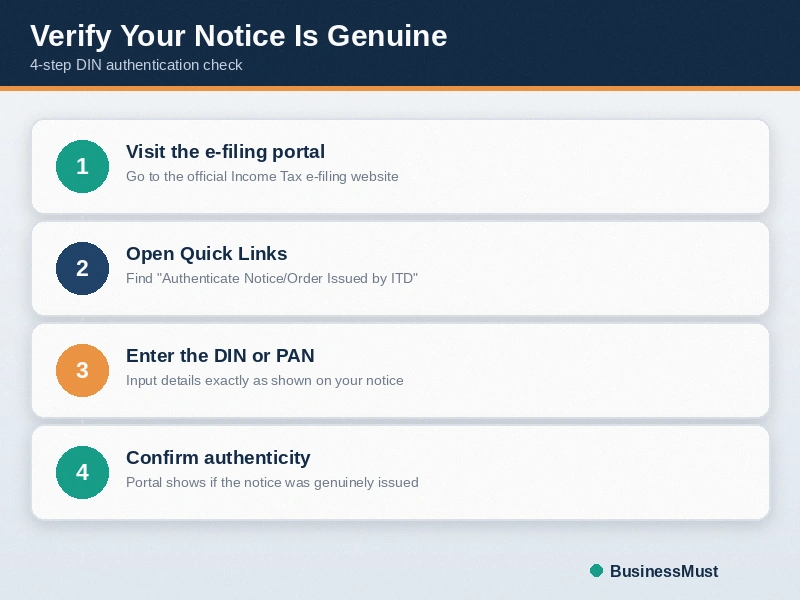
Here is how to check:
- Go to the official Income Tax e-filing portal.
- Look for “Authenticate Notice/Order Issued by ITD” under the Quick Links section. You do not even need to log in to use this tool.
- Enter the DIN mentioned in your notice, or your PAN along with the notice details, depending on which option is available.
- The portal will confirm whether that notice was genuinely issued and show you the basic details of the communication.
Signs a notice might be fake:
- It creates panic and demands immediate payment through a personal UPI ID or bank account
- It arrives only via WhatsApp or a personal email with no DIN mentioned
- The language is oddly urgent or threatens arrest within hours
- It asks you to click a link and enter your bank OTP
Genuine income tax notices never ask you to pay directly to an individual’s account. If a notice fails the DIN check, do not respond to it. Report it and move on. If you are unsure, BusinessMust’s tax advisory team can verify it for you in minutes.
Types of Income Tax Notices and Response Deadlines
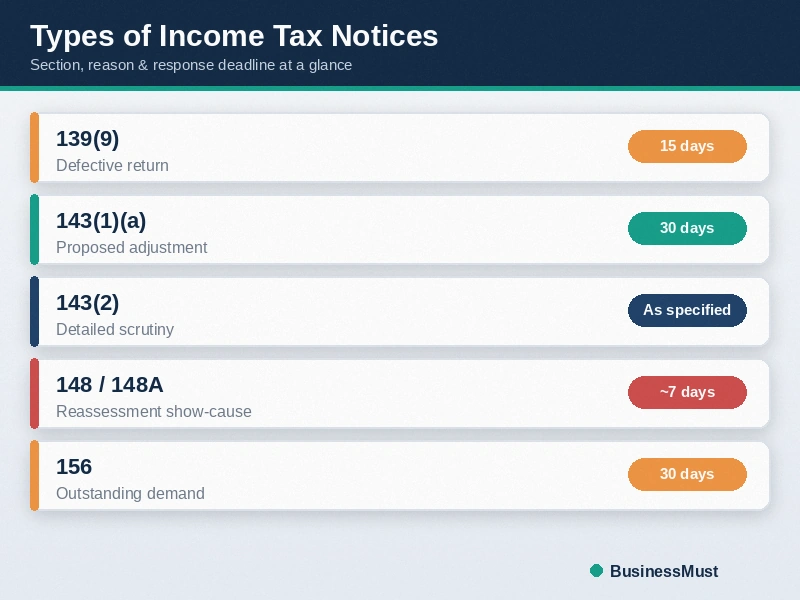
Not all notices are equal, and neither are their deadlines. Missing a 7-day window because you assumed you had a month is one of the most common (and avoidable) mistakes taxpayers make. Here is a quick reference table.
| Section | Why You Got It | Typical Response Window | If You Ignore It |
|---|---|---|---|
| 139(9) | Defective return, missing schedule or mismatch | 15 days | Return treated as invalid, as if never filed |
| 142(1) | AO needs documents or additional info before assessment | As specified in notice | Best judgment assessment under Section 144 |
| 143(1)(a) | Proposed adjustment after processing your return | 30 days | Adjustment finalized without your input |
| 143(2) | Return picked up for detailed scrutiny | As specified, usually with follow-up hearings | Scrutiny proceeds without your explanation on record |
| 148 / 148A | Income believed to have escaped assessment | Often as short as 7 days for 148A | Reassessment proceeds unilaterally |
| 156 | Demand notice for outstanding tax, interest, or penalty | 30 days | Interest accrues, recovery proceedings can start |
| 245 | Refund being adjusted against a past demand | 21 days | Refund gets adjusted automatically |
| 133(6) | Information request from you or a third party like your bank | As specified | Penalty under Section 272A |
A quick real-world example. A freelancer we worked with received a 148A notice on a Friday with a 7-day deadline. He almost missed it because he assumed all tax notices give at least a month, like the 143(1)(a) notice he got the year before. He caught it with two days to spare, but it was close. The lesson here is simple: always check the specific deadline written on your notice, never assume based on a previous experience.
General Structure of an Income Tax Notice Reply Letter
No matter which section your notice falls under, every income tax notice reply format follows a similar skeleton. Once you understand this structure, adapting it to your specific notice becomes much easier, which is especially useful if you are a student learning tax documentation or a CA client trying to sanity-check a draft before it goes out.
1. Sender and recipient details Your name, address, PAN, and the date at the top. Then the recipient block: the Assessing Officer or CPC, along with the relevant office address.
2. Subject line This should reference the exact notice number, the date it was issued, the section, and the assessment year. For example: “Reply to Notice No. XXXXXXXX dated 12.06.2026 issued under Section 143(1)(a) for AY 2025-26.”
3. Opening paragraph A short reference to the notice you received and a polite acknowledgment that you are responding to it.
4. Main body This is where you address each point raised in the notice, one at a time. Do not bundle everything into one paragraph. If the notice raises three issues, use three separate points or sub-headings in your reply.
5. List of enclosures or annexures Every document you are attaching should be listed clearly, numbered, and labeled so the officer reviewing it does not have to guess what each one is for.
6. Closing A polite closing line requesting the officer to reach out if further clarification is needed, followed by your signature block.
Keep the tone factual and calm throughout. Avoid emotional language, avoid over-explaining, and never make claims you cannot back up with a document.
Section-Wise Income Tax Notice Reply Formats (Templates)
This is the part most guides skip or oversimplify with one generic income tax notice reply format for every notice. That does not work, because a reply to a defective return notice reads nothing like a reply to a reassessment notice. Below are ready-to-adapt formats for the most common sections.
Reply to Section 139(9) – Defective Return Notice
Use this when your return has been flagged as defective, usually due to a missing schedule, mismatched figures, or an incomplete form.
[Your Name]
[Address]
[PAN: XXXXXXXXXX]
[Date]

To,
The Assessing Officer / CPC,
[Address as mentioned in notice]

Subject: Reply to Defective Return Notice No. [Notice Number] dated [Date] under Section 139(9) for AY [Year]

Respected Sir/Madam,

With reference to the above notice, I have reviewed the defect(s) pointed out and submit the following clarification/correction:

1. Defect Identified: [As mentioned in the notice, e.g., mismatch in gross total income, missing balance sheet]
2. Correction Made: [Explain what has been corrected and attach the revised return acknowledgment if applicable]
3. Supporting Documents Enclosed: [List documents]

I request you to kindly treat the return as valid based on the correction submitted above. Please let me know if any further clarification is required.

Yours faithfully,
[Your Name]
Reply to Section 142(1) – Request for Documents or Information
Used when the Assessing Officer asks for specific documents or explanations before completing your assessment.
[Your Name]
[Address]
[PAN: XXXXXXXXXX]
[Date]

To,
The Assessing Officer,
[Ward/Circle, Address]

Subject: Reply to Notice under Section 142(1), Notice No. [Number] dated [Date], AY [Year]

Respected Sir/Madam,

In response to your notice under Section 142(1), I am submitting the following information/documents as requested:

1. [Item requested in notice] - [Your response or reference to attached document]
2. [Item requested in notice] - [Your response or reference to attached document]

All supporting documents are enclosed as Annexures A, B, C respectively. I confirm that the information provided is accurate to the best of my knowledge. Kindly let me know if any additional details are required to complete the assessment.

Yours faithfully,
[Your Name]
Reply to Section 143(1)(a) – Contesting a Proposed Adjustment
Used when CPC proposes an adjustment to your return, for example disallowing a deduction due to a mismatch with Form 26AS or AIS.
[Your Name]
[Address]
[PAN: XXXXXXXXXX]
[Date]

To,
CPC, Income Tax Department,
Bengaluru

Subject: Reply to Intimation under Section 143(1)(a), Reference No. [Number], AY [Year]

Respected Sir/Madam,

I am in receipt of the intimation proposing an adjustment to my return for the reasons stated therein. I would like to submit my response as follows:

1. Proposed Adjustment: [State exactly what CPC has proposed to disallow or adjust]
2. My Explanation: [Explain why the deduction/income is correctly reported, referencing the underlying transaction]
3. Supporting Evidence: [List documents such as investment proofs, Form 26AS reconciliation, salary certificate]

Based on the above, I request that the proposed adjustment be dropped and my return be processed as originally filed.

Yours faithfully,
[Your Name]
Reply to Section 143(2) – Scrutiny Assessment Notice
Used when your case has been selected for detailed scrutiny. This one usually needs a more elaborate reply, often built over multiple hearings, so the format below is your opening submission.
[Your Name]
[Address]
[PAN: XXXXXXXXXX]
[Date]

To,
The Assessing Officer,
[Ward/Circle, Address]

Subject: Reply to Notice under Section 143(2), Notice No. [Number] dated [Date], AY [Year]

Respected Sir/Madam,

With reference to the above notice selecting my return for scrutiny, I submit the following details in support of the return filed:

1. Nature of Income: [Salary/business/freelance/capital gains, briefly explained]
2. Basis of Claims Made: [Deductions or exemptions claimed and their justification]
3. Books of Accounts/Records: [Reference to maintained records, if applicable]

I am enclosing the relevant documents as annexures and remain available for any further clarification, hearing, or submission of additional records as may be required.

Yours faithfully,
[Your Name]
Reply to Section 148 / 148A – Reassessment Notice
This is a show-cause notice asking why reassessment should not be initiated. Deadlines here are often very tight, so speed matters as much as content.
[Your Name]
[Address]
[PAN: XXXXXXXXXX]
[Date]

To,
The Assessing Officer,
[Ward/Circle, Address]

Subject: Reply to Show Cause Notice under Section 148A, Notice No. [Number] dated [Date], AY [Year]

Respected Sir/Madam,

With reference to the notice alleging that income chargeable to tax has escaped assessment for the above assessment year, I submit as follows:

1. Information Relied Upon by the Department: [Summarize what the notice cites, e.g., AIR data or high-value transaction]
2. My Explanation: [Explain the transaction, and if it was already disclosed or considered in your original return/scrutiny]
3. Documents in Support: [List proofs such as bank statements, prior assessment order, original ITR computation]

Based on the above, I submit that no income has escaped assessment and request that reassessment proceedings not be initiated. I reserve the right to submit further clarification if required.

Yours faithfully,
[Your Name]
Reply to Section 156 – Demand Notice
Used when there is an outstanding tax, interest, or penalty demand. Your reply depends on whether you agree with the demand or want to dispute it.
[Your Name]
[Address]
[PAN: XXXXXXXXXX]
[Date]

To,
The Assessing Officer,
[Ward/Circle, Address]

Subject: Reply to Demand Notice under Section 156, Notice No. [Number] dated [Date], AY [Year]

Respected Sir/Madam,

With reference to the demand notice raised for AY [Year], I submit as follows:

Option A (if agreeing): I confirm that I have paid the outstanding demand of Rs. [Amount] on [Date] via Challan No. [Number], a copy of which is enclosed. Kindly update your records accordingly.

Option B (if disputing): I respectfully submit that the demand raised does not reflect [state the specific reason, e.g., TDS credit not considered, advance tax not reflected]. Supporting documents are enclosed for your reference. I request rectification of the demand.

Yours faithfully,
[Your Name]
Reply to Section 245 – Refund Adjustment Notice
Used when the department proposes to adjust your current refund against an old outstanding demand.
[Your Name]
[Address]
[PAN: XXXXXXXXXX]
[Date]

To,
CPC, Income Tax Department,
Bengaluru

Subject: Reply to Notice under Section 245, Reference No. [Number], AY [Year]

Respected Sir/Madam,

With reference to the proposed adjustment of my refund of AY [Year] against the outstanding demand of AY [prior year], I submit as follows:

I disagree with the adjustment for the following reason: [State reason, e.g., the earlier demand itself is disputed, already paid, or incorrect]. Supporting documents are enclosed.

I request that the refund not be adjusted until the underlying demand is resolved, or that the adjustment be reviewed based on the evidence submitted.

Yours faithfully,
[Your Name]
Reply to Section 133(6) – Information Request
Used when the department (or a bank/employer on your behalf) is asked to furnish specific information, often related to high-value transactions.
[Your Name]
[Address]
[PAN: XXXXXXXXXX]
[Date]

To,
The Assessing Officer,
[Ward/Circle, Address]

Subject: Reply to Notice under Section 133(6), Notice No. [Number] dated [Date], AY [Year]

Respected Sir/Madam,

With reference to your notice requesting information under Section 133(6), I furnish the following details as requested:

1. [Detail requested, e.g., source of cash deposit of Rs. X on [date]]
2. [Detail requested]

Relevant documents are enclosed as annexures. I confirm my full cooperation in this matter and remain available for any further clarification.

Yours faithfully,
[Your Name]
Worked Examples: Real-World Reply Scenarios
Templates only make sense once you see them applied. Here are three scenarios based on situations people commonly face.
Example 1: Salaried employee, HRA mismatch under 143(1)(a) Priya, a salaried professional in Pune, claimed HRA exemption in her return. CPC flagged an adjustment because her Form 26AS did not show HRA details separately, since her employer had reported it as part of gross salary without a breakup. In her reply, she explained that the HRA exemption was already factored into her Form 16 computation, attached her Form 16, rent receipts, and the landlord’s PAN details, and requested the adjustment be dropped. The adjustment was reversed within a few weeks.
Example 2: Freelancer, cash deposit query under 133(6) Rohan, a freelance graphic designer, deposited a lump sum in cash after a client paid him for a large project in installments over several months, some of it in cash. His bank flagged this and the department issued a 133(6) notice. His reply included a simple breakdown of the deposits, invoices raised to the client, and a signed acknowledgment from the client confirming the payment. Since everything matched, no further action was taken.
Example 3: Small business owner, 80C documentation dispute Anjali runs a small retail business and claimed a deduction under Section 80C for a life insurance premium and PPF contribution. The deduction was disallowed under 143(1)(a) because the premium payment did not reflect properly in AIS due to a delay in reporting by the insurer. She attached the premium payment receipt and PPF passbook copy along with a brief explanation, and the deduction was restored on reassessment.
None of these cases needed heavy legal argument. They needed clear, factual documentation matched to a calm, specific explanation. That is really the entire formula behind a good reply.
Step-by-Step: How to Submit Your Reply on the Income Tax e-Filing Portal
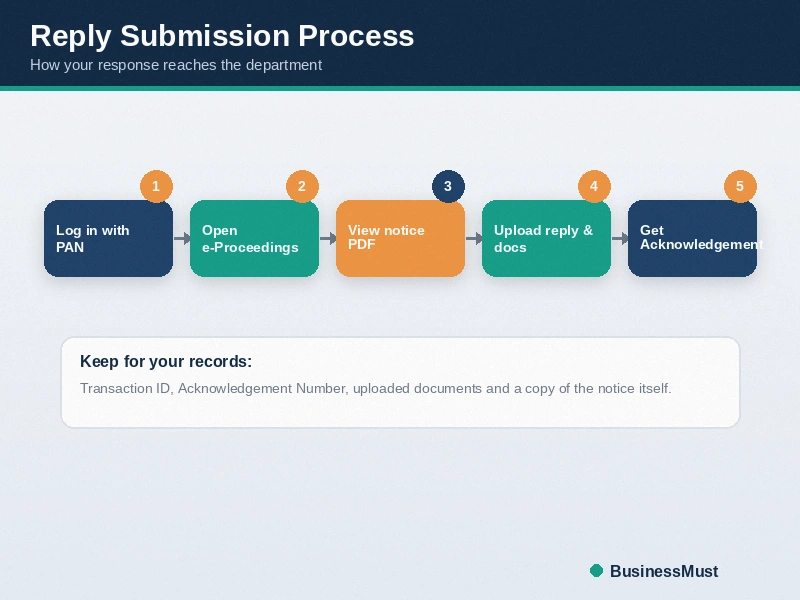
Once your reply letter is ready, here is how to actually submit it online.
- Log in to the Income Tax e-filing portal using your PAN and password.
- Go to “Pending Actions” on your dashboard, then click “e-Proceedings.”
- Select “Self” and then “For Your Action” to view notices requiring a response.
- Click on the relevant notice to open it, and download the “Notice/Letter PDF” if you want a copy for your records.
- Click “Submit Response.” You will be given the choice between a Full Response, if you have everything ready, or a Partial Response, if you need to submit some documents later.
- Upload your reply letter and all supporting documents. Stick to PDF format where possible and keep individual file sizes reasonable, as the portal does enforce size limits.
- Review everything once before final submission, since edits after submission are not straightforward.
- On submission, you will receive a Transaction ID and Acknowledgement Number. Save both, along with a copy of everything you submitted.
Keep a personal folder, physical or digital, with a copy of the notice, your reply, all annexures, and the acknowledgment. This becomes invaluable if there is any follow-up months later.
Documents and Annexures Checklist by Notice Type
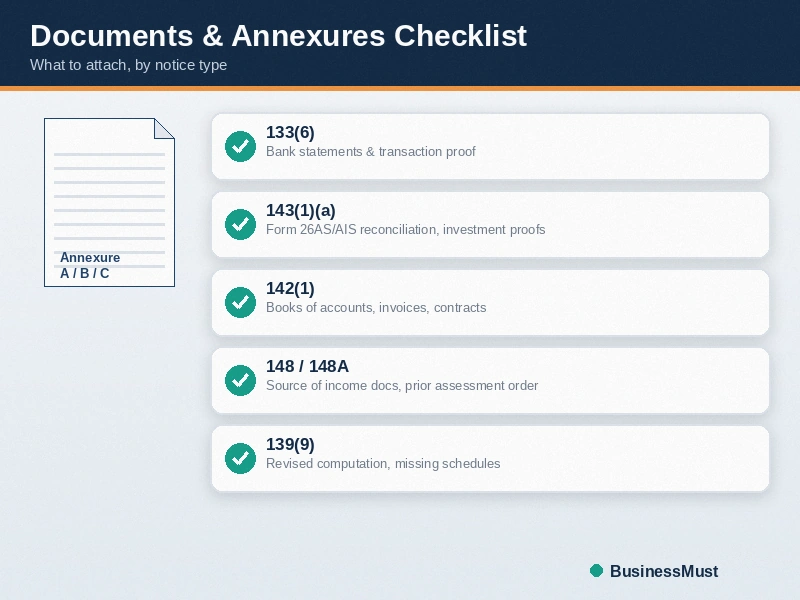
Different notices need different proof. Here is a quick checklist to keep handy.
- Section 133(6): Bank statements for the relevant period, transaction-wise breakdown, invoices or agreements explaining the source of funds
- Section 143(1)(a): Form 26AS and AIS reconciliation, investment proofs (LIC, PPF, ELSS receipts), Form 16 or salary slips, rent receipts if HRA is involved
- Section 142(1): Books of accounts, purchase and sale invoices, bank statements, loan agreements, contracts relevant to the query raised
- Section 148/148A: Documentation showing source and nature of the disputed income, copy of the original return and computation, prior assessment order if one exists
- Section 139(9): Revised computation sheet, missing schedules, balance sheet and profit and loss account if you run a business
A general habit worth building: label every document clearly (Annexure A, Annexure B) and reference that label in your reply letter itself. Officers reviewing dozens of cases a day appreciate a submission that is easy to follow, and it genuinely speeds up resolution.
Requesting a Deadline Extension or Authorizing a Representative
Sometimes you simply cannot gather everything in time, and that is fine as long as you ask before the deadline, not after.
Extension request format:
Subject: Request for Extension of Time to Reply to Notice No. [Number] dated [Date], AY [Year]

Respected Sir/Madam,

With reference to the above notice requiring a response by [Date], I request an extension of [X] days to submit a complete response, since [reason, e.g., documents are being collected from a third party, travel, medical reasons].

I assure you of my full cooperation and request your kind consideration.

Yours faithfully,
[Your Name]
If you are working with a Chartered Accountant, they will often need a formal authorization to reply on your behalf. Here is a simple version:
Subject: Authorization Letter

I, [Your Name], PAN [XXXXXXXXXX], hereby authorize [CA Name], holding Membership No. [Number], to represent me before the Income Tax Department in connection with Notice No. [Number] dated [Date] for AY [Year], and to submit documents and responses on my behalf.

[Your Signature]
[Date]
If you are still deciding whether to handle this yourself or bring in a professional, BusinessMust’s guide on How to Choose a Chartered Accountant in India walks through when it genuinely makes sense to get help.
Special Considerations for NRIs Responding to Income Tax Notices
NRIs face a slightly different set of challenges when a notice lands in their inbox. A few things worth knowing:
- Notices often relate to NRO account transactions, foreign remittances, or claims made under a Double Taxation Avoidance Agreement (DTAA). These need documentation that clearly links the transaction to foreign income already taxed elsewhere.
- Time zones and physical distance make quick portal action harder, so it is worth setting up email and SMS alerts on the portal well in advance so you never miss a notice by days.
- If you cannot log in and respond yourself in time, a simple Power of Attorney authorizing a representative in India, ideally a CA familiar with your finances, is often the most practical solution.
- Digital signature or e-verification from abroad can sometimes be tricky, depending on your bank’s OTP setup, so it helps to test this once before an actual notice deadline is ticking.
If DTAA claims are part of your situation, BusinessMust’s NRI Taxation Guide covers this in more depth.
Common Mistakes to Avoid When Replying to an Income Tax Notice
- Waiting until the last day. Deadlines for some sections are shorter than people expect, and last-minute technical glitches on the portal are common.
- Giving vague answers. “The income was already reported” without a document to back it up rarely resolves anything.
- Forgetting to attach documents. A well-written letter with no annexures leaves the officer with nothing concrete to act on.
- Assuming every notice is a scam and ignoring it. Verify the DIN first, but once verified, treat it seriously.
- Trying to handle a complex scrutiny case entirely alone. Simple mismatches are usually fine to handle yourself. Reassessment notices or scrutiny involving business income often benefit from a professional review before submission.
What Happens After You Submit Your Reply?
Once submitted, you will typically see one of these outcomes:
- The matter is closed, and you will see a status update reflecting this on the e-Proceedings dashboard
- The officer may seek further clarification, in which case a follow-up notice or hearing request follows
- An order is passed based on your reply, either accepting your explanation or making an adjustment
You can track the status anytime under “e-Proceedings” on the portal. If an order is passed that you disagree with, the next step is usually filing an appeal with the Commissioner of Income Tax (Appeals), which is a separate process with its own timelines.
FAQs
Can I reply to an income tax notice myself, or do I need a CA?
For straightforward notices like a 143(1)(a) adjustment with a clear documentation trail, most people can reply themselves. For scrutiny under 143(2), reassessment under 148, or anything involving business income and multiple transactions, a CA’s review is usually worth the cost, since the wording and legal positioning matter more.
What is the penalty for not responding to an income tax notice?
It depends on the section. Non-response can lead to a best judgment assessment under Section 144, which usually works against you, or a penalty under Section 272A for notices like 133(6). In serious cases, prosecution is possible, though this is rare and usually follows repeated non-compliance.
How do I know if my income tax notice is genuine?
Use the “Authenticate Notice/Order Issued by ITD” tool on the e-filing portal and enter the DIN mentioned on your notice. If it does not have a DIN or fails verification, treat it as suspicious.
Can I request more time to respond to a notice?
Yes, you can submit an extension request explaining your reason before the deadline passes. Approval is at the discretion of the Assessing Officer, so it is best to ask as early as possible rather than waiting until the last day.
What is the difference between Section 143(1) and 143(2) notices?
Section 143(1) is an automated intimation sent after your return is processed, essentially confirming or proposing minor adjustments. Section 143(2) means your return has been selected for detailed scrutiny, involving a more thorough review, often with a face-to-face or virtual hearing.
Do NRIs need a different process to respond to notices?
The portal process is the same, but NRIs often need to prepare documentation around foreign income, DTAA claims, or NRO account transactions, and may find it practical to authorize a representative in India to handle submissions if time zones or connectivity make quick responses difficult.
Before You Submit, Get a Second Look
Templates get you most of the way there, but tax notices rarely come with a one-size-fits-all answer. A small wording choice or a missing document can change how quickly a matter gets resolved. If your notice involves scrutiny, reassessment, or anything beyond a simple mismatch, it is worth having it reviewed before you hit submit.
BusinessMust’s tax advisory team reviews income tax notices for individuals, freelancers, small business owners, and NRIs every day, and can help you get the income tax notice reply format right the first time, so nothing gets missed before your deadline.
Got a notice with a deadline coming up? Don’t risk a rushed reply. Get your income tax notice reviewed by BusinessMust’s tax experts today and have a compliant response ready before your deadline hits.