

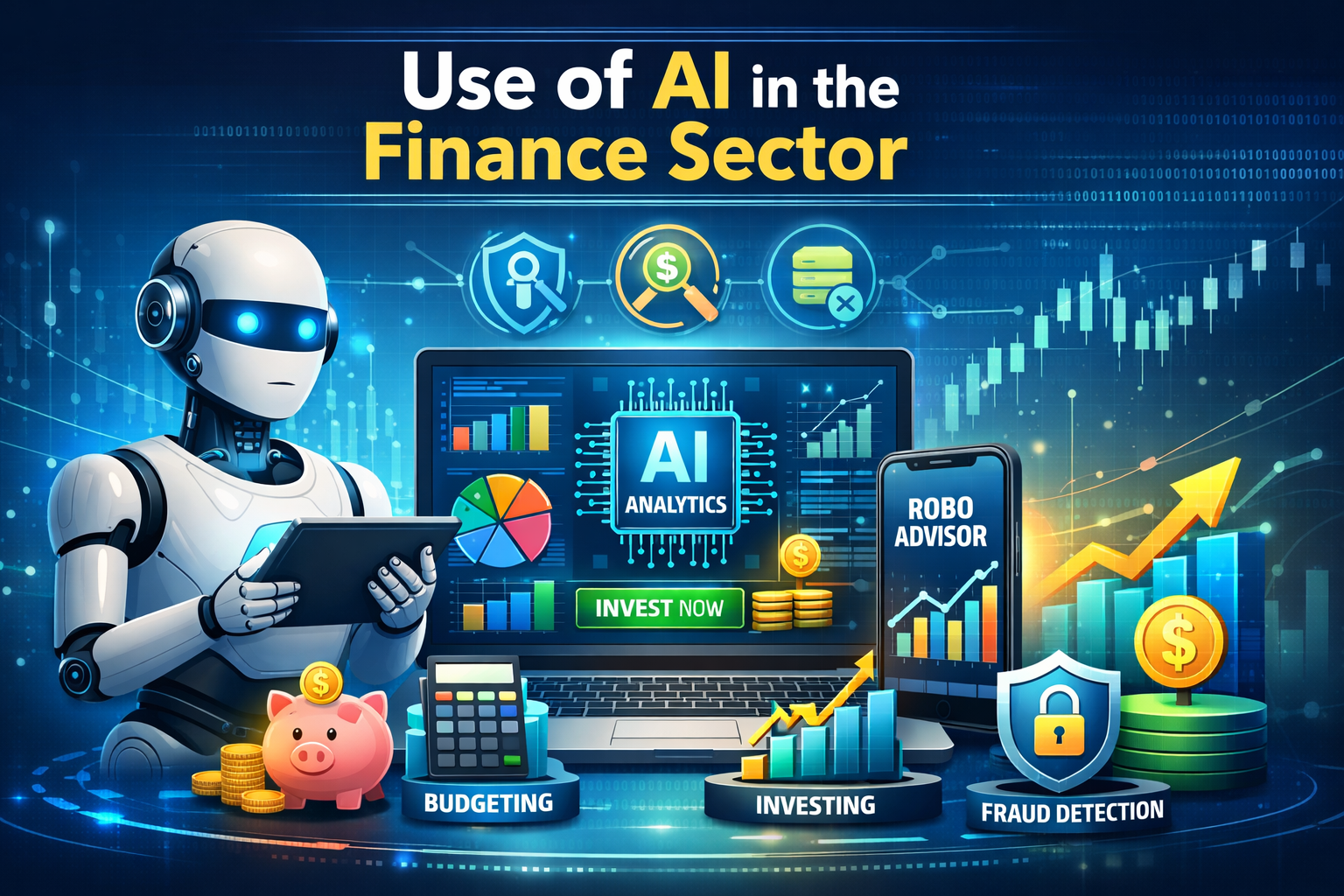
Just a couple of years ago, the notion of artificial intelligence managing our money seemed outlandish, something out of a science fiction novel. Today, it is not only real but deeply entrenched in how we save, invest, spend, and plan for our financial lives. AI in Finance Indeed, whether they know it or not, AI has underpinned so many of the apps and services that are used every single day when making financial decisions.
General Use of AI in the Finance Sector. We talk briefly about automated budgeting tools, robo-advisors, and data analytics trends without getting into too much mental math or technical jargon, but instead draw out allthe real-world relevance a human deserves.
Decoding AI in the Financial Services Industry (Without the Hype)
AI in finance does not work like robots replacing humans overnight. It’s not about robots replacing people, instead it’s about machines learning from data and assisting people in making better financial decisions more quickly and with fewer mistakes.
Today, banks, fintech startups, investment firms, and even end-users depend on AI-driven systems to:
- Analyze massive financial data sets
- Predict spending behavior
- Assess risk more accurately
- Offer personalized financial advice
That sort of practical problem-solving mindset is exactly what Use of AI in the Finance Sector is all about.
Automated Budgeting Tools: Intelligent Daily Money Management
Budgeting is boring for everyone, time-consuming for many, and continues to be ignored by most. AI has changed that.
How Automated Budgeting Tools Work
AI-driven budgeting apps sync with your bank accounts and then help you to automatically:
- Classify costs (meals, housing, transportation, and subscriptions)
- Track income vs spending
- Detect unusual transactions
- Forecast the future costs based on past behaviour
The thing is, unlike manual spreadsheets, these tools learn your habits over time. If you overindulge around holidays or travel seasons, the AI-meter takes that into account for future budgets.
Why Are People Adopted So Quickly
The greatest benefit is the ease with which you can now be mindful of money. You don’t have to be a financial genius. The system operates silently in the background and gives you gentle nudges when it looks like something isn’t quite right.
Its real-world applicability, on the other hand, makes automated budgeting one of the most easily relatable examples of the Use of AI in the finance industry.
Robo-Advisors: Investing Without the Intimidation
Investing the old-fashioned way can often be a daunting, exclusive process. Robo-advisors aim to change that.
What Are Robo-Advisors?
Robo-advisors are software platforms that offer algorithm-driven portfolio management advice and automatically invest your money in:
- Your age
- Income
- Risk tolerance
- Financial goals
Instead of getting advice from a human adviser, you take the quiz. The AI software then creates and oversees a diversified portfolio for you.
Key Benefits of Robo-Advisors
- Low fees: The lowest fees in comparison to traditional advisors
- Accessibility: Great for beginners and small-time traders
- Consistency: Emotion-free decision making
- Auto rebalancing: Because markets evolve, so do our portfolio allocations
For millennials and newbies first entering the investment world, robo-advisors have made investing less scary – yet another great instance of the Use of AI in the finance sector in our everyday life.
Data Analytics: Unlocking the Understanding behind the Numbers
Finance has always been data-driven. What has changed is the velocity and sophistication with which data is analyzed.
AI-Powered Data Analytics Role
AI can evaluate millions of transactions in seconds and find patterns that humans may overlook, aiding the financial services industry:
- Detect fraud in real time
- Predict credit risk more accurately
- Forecast market trends
- Personalize financial products
Now, for instance, banks can dole out personalized interest rates for loans based on a customer’s actual spending and repayment patterns instead of relying solely on credit scores.
This transition from reactive to predictive decision-making is the real value of the Use of AI in Finance.
AI in monitoring fraud and risk
Security is one of the most important impacts of AI in finance.
Smarter Fraud Detection
AI models track transactions in real time and alert on some of the following behavioral anomalies:
- Sudden large withdrawals
- Unusual foreign transactions
- Repeated failed login attempts
The AI learns new fraud patterns as opposed to a static rule-based system.
Better Risk Assessment
AI also enables lenders and insurers to assess risk using alternative data – including things like:
- Spending habits
- Utility payments
- Transaction frequency
This makes financial inclusion a more just process, especially for those with less of a credit history, another outcome benefit of the Use of AI in the financial sector.
The Human Touch vs The Machine Mind: Balancing Act
A perennial question: Will AI take over human jobs in the realm of finance? The reality is more balanced.
AI deals with repetitive tasks, calculating, sorting data, and estimating, leaving humans to focus on:
- Strategy
- Emotional intelligence
- Complex decision making
- Customer relationships
So it is not to replace the Use of AI in the Finance Sector but rather to work along with it.
Challenges and Ethical Considerations
Though AI in finance has its advantages, there are concerns:
Data Privacy
AI is particularly dependent on personal financial information. The guarantee of data security and ethical use can not be overstressed.
Algorithm Bias
When the data with which an A.I. system is trained is biased, it can unfairly reject loans or misjudge risk.
Over-Reliance on Automation
“Simply relying on AI without human oversight can result in expensive mistakes when unexpected market events occur.
Responsible Implementation is Key. The Trust the Use of AI in Financial Services Depends on it.
The Future of AI in the Finance Sector
AI in the future. In the future, artificial intelligence will probably be even more infused within finance by:
- Voice-based financial assistants
- Hyper-personalized investment strategies
- Real-time financial coaching
- Predictive wealth planning
As innovation continues, the AI Tech in Finance will shift from a competitive edge to a standard requirement.
Final Thoughts
AI is not just a buzzword in finance anymore; it’s a quiet revolution. Whether it’s assisting customers to budget better, providing investment advice through robo-advisors, or enabling institutions for deep data analytics, AI is changing how we experience money.
This is perhaps the true victory of the use of AI in the Finance Sector: it can make difficult decisions easier, less prone to error, and financial tools for everyone, while never dehumanizing that which trust and judgment need.
The challenge for users is therefore not to be afraid of AI, but to know how to use it, and to remain vigilant as finance increasingly mutates.
FAQs
1: What is AI really used for in finance today?
AI industry is widely deployed in financial services include automated personal budgeting, fraud detection with credit card transactions analysis, consumer credit risk assessment, and robo-advisors for investment management and financial planning. It can assist financial institutions in quickly analyzing large amounts of data and lowering the rate of error introduced by human users, as well as providing users with personalized financial solutions.
2: Are robo-advisors secure for long-term financial planning?
Yes, robo-advisers are pretty safe for long-term investment planning if you’re going through regulated platforms. They automatically rebalance and use data-driven strategies, with diverse portfolios to help beginners as well as investors who want to see lower fees launch into the world of passive investing.
3: Do AI budgeting tools really help you save money?
AI-enabled budgeting tools can cut down on expenses through monitoring of spending patterns, spotting unnecessary lifestyle costs, and timely alerts. Throughout their use, these apps can learn users’ behavior and recommend wiser personal finance decisions without asking for any effort from the users themselves.
4: Will artificial Intelligence take over human financial advisers in the future?
AI probably won’t ever completely replace human financial advisers. It does not replace advisors; the robots give them a break from the mundane number crunching and data analysis, so that they can get on with higher value-based advice, emotional support, and complex financial planning.
5: Risks related to the application of AI in finance?
The biggest risks are privacy issues with data, biased algorithms, and over-reliance on “black box” systems. Such risks can be minimized by strong regulation, transparent algorithms,s and using the human right to work so no one simply gives in.
Must Read-: Personal Finance in 2026: What’s Changing in Mobile-First Banking and Savings Trends
