

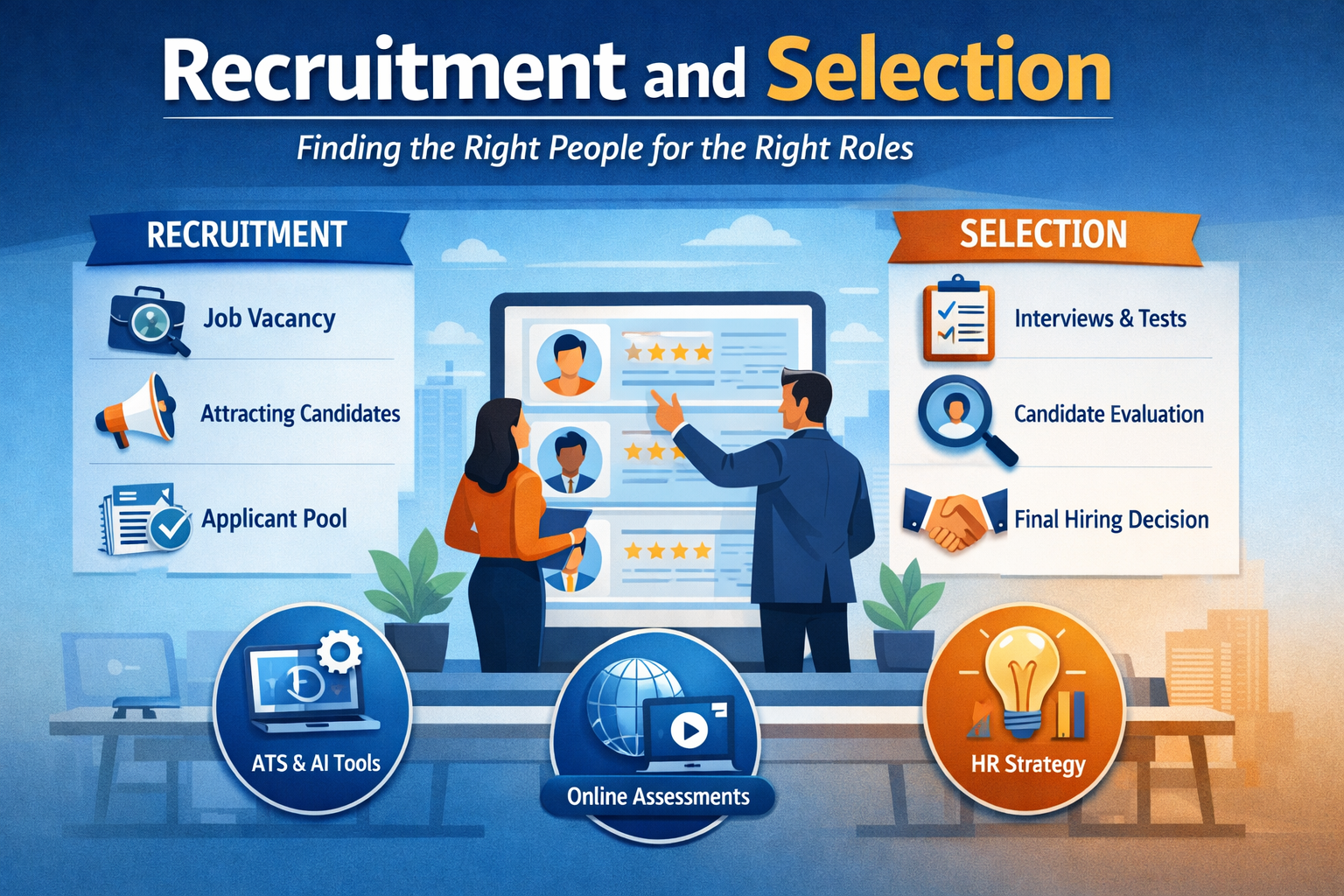
Every organisation runs on people. There’s no amount of technology, strategy or insight that can make a business successful without having the best people in place to fulfill the roles they need fulfilled. That’s why the recruitment and selection is one of the most important function of human resource management.
There’s more to recruiting and choosing than just finding people for open jobs. One done right, they drive productivity and cut down on employee churn, fostering a healthy work culture.. In today’s highly competitive job market, organisations that follow a structured and thoughtful hiring process gain a clear edge over their competitors.
Meaning of Recruitment and Selection
While related to each other, recruitment and selection serve separate functions in the hiring process.
Recruitment
Recruitment is the process of identifying job vacancies and attracting potential candidates to apply for them. The main goal is to generate interest and build a strong pool of qualified applicants who meet the job requirements.
In simple terms, recruitment is about reaching out to the right talent and encouraging them to apply.
Selection
Selection starts when the applications come in. It requires a close look at the candidates to select the right person for the job. This is the phase to evaluate skills, experience, attitude and how well a candidate will fit the company culture.
Selection is about making the best possible hiring decision.
Difference Between Recruitment and Selection
| Basis | Recruitment | Selection |
|---|---|---|
| Meaning | Attracting candidates for a job | Choosing the best candidate |
| Nature | Positive process | Eliminating unsuitable candidates |
| Objective | Increase the number of applicants | Identify the most suitable person |
| Outcome | Pool of potential candidates | Final appointment |
| Cost Involved | Comparatively low | Comparatively high |
Key Stages in the Recruitment and Selection Process
An effective recruitment and selection process form the basis of all satisfaction, productivity and performance.
Workforce Planning and Job Analysis
The first step is determining existing and future personnel requirements. HR departments design specific job descriptions and job specifications which identify requirements, required skills, duties and responsibilities for the job.
Attracting Candidates
Jobs are advertised on internal and external platforms, such as an employer’s company website, vacancy pages, job boards, social media and by employee referrals. Smart job postings draw in the candidates most likely to be a fit for the role.
Application Screening and Shortlisting
Applications are assessed and based on the appropriateness to the job requirements, applicants who meet desired criteria would be shortlisted.
Tests and Interviews
Shortlist may have to pass further interviews, skills tests, or assessments of their technical ability, problem-solving skills, and whether they are a good culture fit.
Final Selection and Job Offer
After careful evaluation, the best candidate is selected and offered the job. This stage may include salary discussions and final approval.
Onboarding
After the representative is hired, onboarding supports their transition into the company and helps them to acclimate to the organizational culture as well as getting a handle on company policies and begin making meaningful contributions.
This systematized methodology provides consistency, objectivity and improved hiring results.
Role of Technology in Recruitment and Selection
Technology has redefined how businesses recruit talent, making the process faster and more reliable than ever.
| Technology | Benefits |
|---|---|
| Applicant Tracking Systems (ATS) | Automates resume screening and application tracking |
| AI-based Hiring Tools | Improves candidate matching and reduces bias |
| Video Interviews | Saves time and hiring costs |
| Online Skill Assessments | Quick and objective evaluation |
| HR Analytics | Enables data-driven hiring decisions |
Technology enables organizations to speed up time-to-hire and greatly enhance the candidate experience.
Challenges in Recruitment and Selection
Despite its importance, organisations face several hiring challenges, including:
-
Shortage of skilled talent in specialised roles
-
Difficulty balancing technical skills with cultural fit
-
Rapid changes in recruitment technology
-
Managing high volumes of applications efficiently
Overcoming these challenges requires continuous improvement in hiring strategies and smart use of modern recruitment tools.
Technology’s Growing Role in Modern Recruitment
Today’s recruitment environment is evolving rapidly:
-
ATS platforms help manage job postings and candidate pipelines
-
AI-powered tools support candidate sourcing and predictive hiring
-
Online interviews and assessments enable global talent access
When implemented, they enhance efficiency and boost employer branding as well as candidate experience.
Conclusion
Hiring and selection are anything but a standard HR functions; they are strategic exercises that defines the future of an organisation. It all starts with percent screening being the first rung on the ladder to hiring A-players who consistently perform, have longer tenure and better fit in your company.
When recruitment and selection are implemented in a methodical, organized manner, it serves as an efficient tool to attract prospective employees with the essential competencies and keep hold of them with an enriched job satisfaction for the organization’s benefits.
FAQs
1. What is the main difference between recruitment and selection?
Recruitment involves attracting candidates for a position, selection is the process of choosing the most promising candidate from those available, based on eligibility criteria like ability & performance.
2. Why are recruitment and selection important for an organisation?
A good recruitment and selection process enables organisations to attract the right staff, employ the right people for job roles, improve staff output by providing them with relevant skills-sets; reduces employee turnover rates and cultivates a healthy organisational culture. Bad hires can be expensive and unproductive.
3. What are the main steps involved in the recruitment and selection process?
They are tackling the key steps of human resources which is workforce planning, job analysis, attracting candidates, processing applications, making interviews and tests for them, making a decision and finally receive the employee who will work in.
4. How does technology help in recruitment and selection?
Technology, including ATS and AI-based hiring tools as well as online assessments and video interviews not only expedites the hiring process but also creates a more accurate process and better candidate experience.
5. What challenges do organisations face in recruitment and selection?
Typical hurdles can be difficulty finding talent, overwhelming volume of applications, determining cultural fit and advancing with the latest recruitment approaches or market conditions.
Must Read-: AI Agents: Understanding Their Role and Impact in Modern Businesses
