

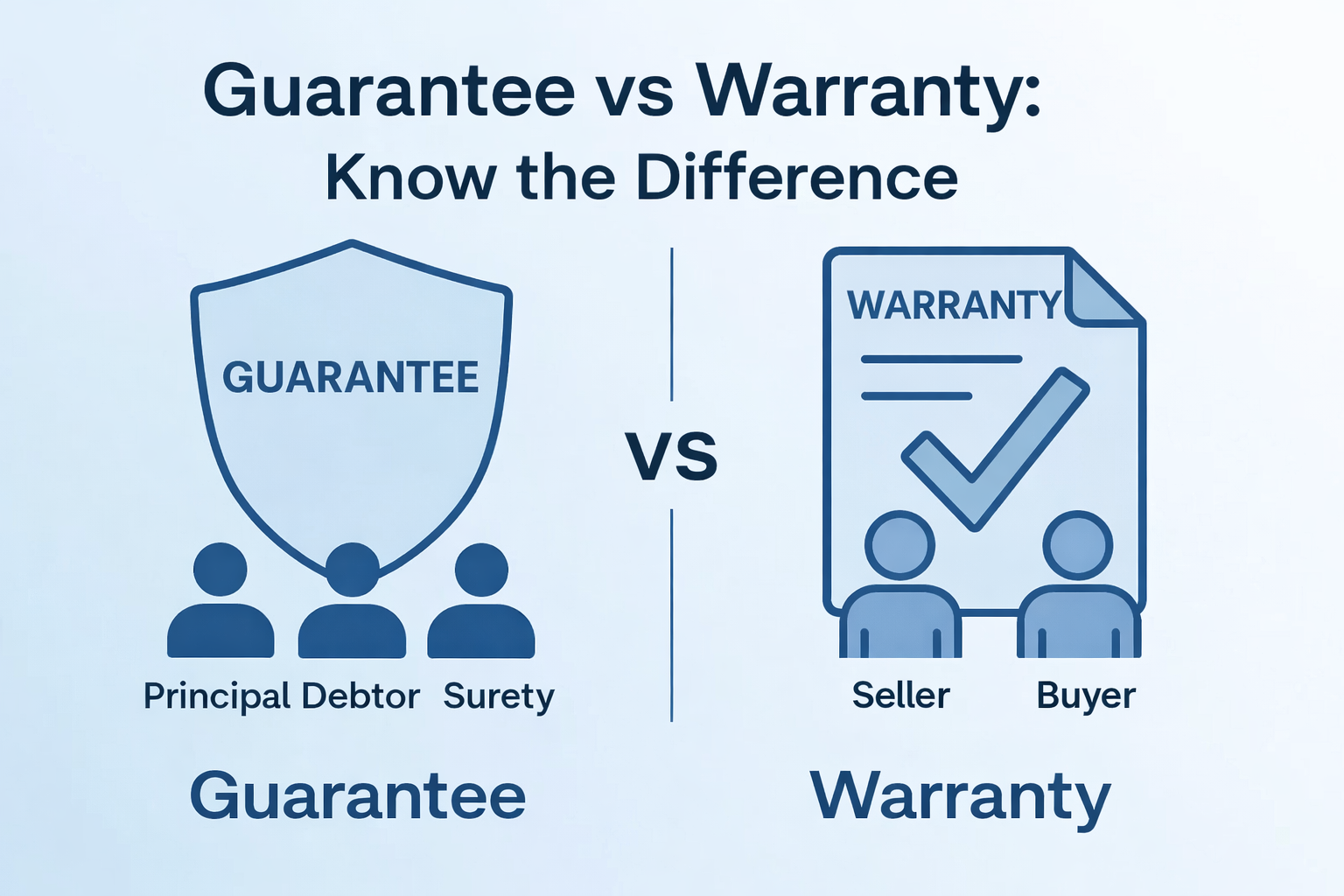
In the consumer-oriented marketing age of today, Difference Between Warranty and Guarantee have become familiar sights on packaging, labels and advertising for products. They may sound similar, and both are in place to look after buyers, but they’re very different things that have distinct legal meaning with regard to their scope and use. Knowing the distinction between warranty and guarantee can help you to be a more informed consumer, ensure that your consumer rights are protected, and enable you to better judge product claims before purchasing a product.
What Is a Warranty?
A warranty is a written guarantee, issued to the purchaser of an article by its manufacturer, promising to repair or replace it if necessary within a specified period of time. It will tell you that how long the object should work normally. If an item breaks as a result of the manufacturing process or because of issues with the materials used during production, the manufacturer is legally responsible in most cases to either fix, replace or – on occasion – provide you with your money back according to conditions outlined in the warranty.
Key Characteristics of a Warranty
- Written Warranty-: A warranty usually in documented form, such as a card of warranty, instruction book, bill or guarantee certificate.
- Time bound -: Tt covers the product for a specific period, such as 6 months, 1 year or more.
- Legal Responsibility -: Warranties are a legal responsibility on the seller or manufacturer. If the terms are not met, legal action can be taken.
- Limited Coverage -: They typically provide limited coverage for a particular defect or failure due to a workmanship, or the use of materials that will need repair and replacement.
- Conditions -: There are typically conditions consumers must meet, such as holding onto receipts, registering a product or carrying out regular maintenance.
Example of a Warranty
Let’s say that you purchase a brand new refrigerator and it comes with a 2-year warranty. Within that period, if your compressor stops working because of a defect in workmanship or materials from the manufacturer, they must repair or replace it at no cost to you as long as you meet its other warranty terms (like providing proof of purchase).
What Is a Guarantee?
A warranty is a commitment made by the seller, manufacturer, or service provider of their product or service during a sale that additional post-sale support such as repair will be accompanying the goods. Unlike a warranty, a guarantee can be more vague, less formal and not necessarily require extensive written documentation though many companies will provide it in writing to clear up any confusion.
Key Features of a Guarantee
- Warranty or Guarantee -: A promise is nothing but a commitment that the product will deliver whatever is noted on the box (or) it should fulfill consumer expection.
- Loose Form-: It can be oral or written, and often not enforceable unless in writing.
- More General -: Warranties can include general satisfaction, client smiles, quality or performance not exclusively defects.
- Less stringent Claim Requirements-: Qualifying for a warranty claim is usually more difficult compared to claiming a guarantee.
- Example of a Guarantee
A skincare company may claim “100% satisfaction or your money back.” Even without a manufacturing defect, the company may give you your money back or an alternative product if yours didn’t meet expectations.
Understanding the Difference Between Warranty and Guarantee
Below is an in-depth analysis on warranty vs guarantee.
1. Legal Status
- Warranty: Legally enforceable and binding. If the company violates the promise, the consumer can sue.
- Guarantee: Often a goodwill pledge. It may not be enforceable in law if it is not in writing and included within a contract.
2. Documentation and Formality
- Warranty: The warranty is typically official and written out, sometimes in the product literature.
- Promise: May be formal or demonstrated through informal practice. Sometimes oral, or in advertisements.
3. Time Duration
- Warranty: Always associated with a certain point in time.
- Guarantee: None or can be for a specific period (e.g. 30-day satisfaction guarantee). Long-term or lifetime warranties are standard in some fields.
4. Scope of Coverage
- Warranty: Primarily covers defective workmanship or breakdowns.
- Guarantee: More general, frequently would cover satisfaction, performance or quality promises.
5. Claims and Compensation
- Warranty: In general, provides for repair or replacement. Occasionally refund if repair is not possible.
- Guarantee: Often includes repair, replacement or refund. Is not always about fixing; customer satisfaction is most important.
6. Transferability
- Warranty: May be attached to the original owner and not transfer, if you sell your device to a new owner.
- Guarantee: Terms applicable, in particular with lifetime warranties, may be transferable to new owners.
Practical Scenarios: Warranty vs. Guarantee
Understanding them in practical contexts such as warranties and guarantees can help to make their use cases clearer:
Electronics and Appliances
Expensive things like laptops, refrigerators and cars usually come with warranties. These are specific contracts that spell out what is covered — parts, labor and service conditions, for instance for a stated period of time. Manufacturing defective failures are typically repaired by warranty at no charge.
Consumer Goods and Satisfaction Claims
Goods like cosmetics, clothing or food frequently carry guarantees such as “money back if not satisfied within 30 days.” These are intended to inspire confidence rather than fulfil a legal requirement.
Extended Protection Plans
Some retailers offer extended warranties, which are voluntary plans that extend insurance coverage for a longer period than the usual time frame and against an additional cost. Guarantees are not usually sold this way; they are a part of the original promise of what the product will do.
Why Knowing the Difference Matters
Understanding the distinction between guarantee and warranty as well as it’s definition with example sentences.
- Help you better evaluate product claims.
- Prevent misunderstanding of consumer rights.
- Aid in making informed purchasing decisions — particularly for higher-end or longer-term purchases.
- Explain how and to what you can make this right if a product fails or does not meet expectations.
Conclusion
Difference Between Warranty and Guarantee serve the purpose of protecting customers and ensuring that products meet certain standards, the two concepts vary greatly in terms of formality, enforceability, longevity and coverage. A warranty is a documented, signed agreement between the Client/product user and provider protecting against faults for a specified time. A warranty, on the other hand, is a more general assurance of performance or satisfaction that may be express or implied and may not be related directly to product defect.
When you know the meaning of warranty vs. guarantee, you’ll be able to move forward with purchases more confidently and make better choices and you won’t get any surprises when things go wrong!
Must Read-: Credo Brands Marketing IPO GMP – Date-Wise Trend, Comparison & Detailed Analysis
